
Given an array of integers, create another array whose i‘th element contain the product of all the elements in original array except the i’th element in original array.

Method-1 (Wrong): b[i] = product / a[i]
The first attempt to answer this question is generally to take product of all the numbers and then divide the product by a[i] to get b[i].
void multiplyMat(int* a, int* b, int n)
{
    int prod = 1;
    for(int i=0;i<n;i++){
	      prod *= a[i];
    }
    for(int i=0;i<n;i++){
	      b[i] = prod/a[i];
    }
}
Try running this code for {0, 1, 2, 3, 4} and the code will crash at run-time (because of division by zero – a[0] is zerp, when the below statement is executed inside the for loop,
b[0] = prod/a[0];
It will crash. So, change the code to:
if(a[i] != 0)
    b[i] = prod / a[i];
Method-2 (Without using division operator).
The interviewer may ask you write code without using division operator and it should still take O(n) time and constant extra space.Here is the solution:
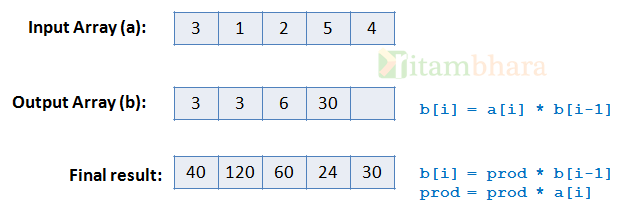
Algorithm:
1. Set all the elements in array b such that
    b[i] = b[i-1] * a[i].
2. prod = 1;
3. for(i=n-1; i>0; i++)
        b[i] = b[i-1] * prod;
        prod = prod * a[i];
Code:
/**
 * i'th element of b will be product of all the elements of a except a[i]
 * a - Input Array
 * b - Result Array
 * n - Size of both the arrays
 */
void multiplyMat(int* a, int* b, int n)
{
    b[0] = a[0];
	for(int i=1;i<n-1;i++){
	      b[i] = b[i-1] * a[i];
    }
   int prod = 1;
   for(int i=n-1; i>0; i--){
	     b[i] = b[i-1] * prod;
	     prod *= a[i];
   }
   b[0] = prod;
}

I think this should also work!!!
void multiplyMat(int* a, int* b, int n)
{
for(int i=0;i<n;i++){
for(int j=0; j<n; j++){
if (i != j)
b[i] *= a[j];
}
}
}